
Consulting firm · AI integrator
Your company that breathes without you,autonomous systems that execute, decide, and deliver.
From scoping to deployment — we integrate your AI agents into your information system, within your regulatory constraints.
0+
companies supported on AI agent integration
0 wks
average time from scoping to first agent in production
0%
average reduction in processing time on automated workflows
0%
engagements renewed or extended
Live demos
Our systems, up and running
Ask a question, launch the agent, arbitrate the schedule — seven interfaces you can drive yourself, right here.
Expertise
Two pillars, one trajectory
agent-factory
In productionTurning your business processes into AI agents that actually run in production
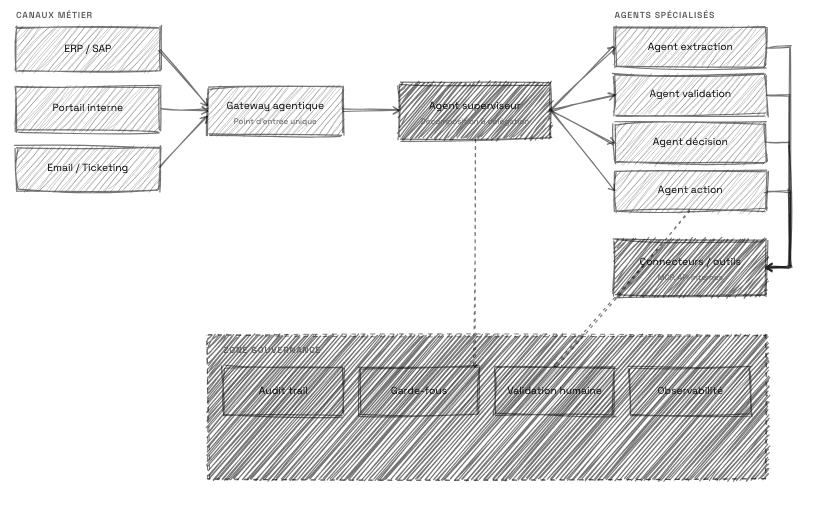
We scope the highest-value use cases, choose the agentic platform suited to your context (not the other way around), and orchestrate the specialized agents required — extraction, validation, decision, action. Every engagement includes governance and ROI measurement from sprint 1, not at the end of the project.
Scoping business use cases and prioritizing by value/effort
Choosing the agentic platform: LangGraph, Microsoft Foundry, N8N, or a proprietary stack
Multi-agent orchestration and guardrail design
AI governance, audit trail and ROI measurement from day one of deployment
Change management with business teams
integration-engine
In productionIntegrating your AI agents into your information system without disruption
An AI agent that can't talk to your ERP, your CRM or your business tools is just a demo. We build the integration layer — connectors, APIs, the MCP protocol — that links your agents to your legacy systems (ERP, SAP, proprietary platforms), and coordinate with your teams or cloud partners on the underlying infrastructure: cloud architecture isn't our trade, integrating agents into your existing systems is.
Connectors and APIs between AI agents and business systems (ERP/SAP, CRM, legacy)
Integration via the MCP protocol and internal APIs
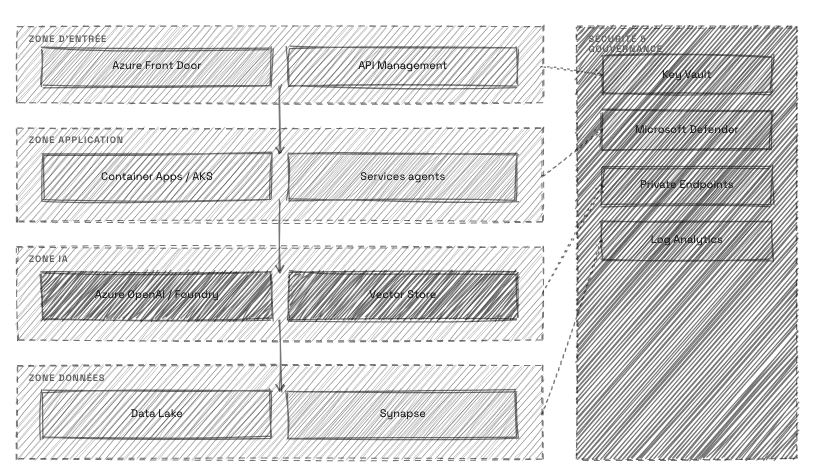
Specifying infrastructure requirements, in coordination with your teams or cloud partners
Going from POC to production: testing, continuous evaluation, phased rollout
AgentOps: observability and reliability of agents once in production
AI governance & compliance in regulated industries
Scoping ACPR, Solvency II, IFRS 17 or DORA requirements for AI agent deployments in heavily regulated environments.
MLOps & AgentOps
Setting up the observability, continuous evaluation and versioning pipelines needed to operate AI agents reliably in production.
Audit & strategic scoping
AI maturity diagnostics, mapping of viable use cases, and a prioritized integration roadmap over 12 to 18 months.
Why Paradigm
Five reasons our clients renew their engagements
renewal-audit
Engagements renewed
87 %
Agents still in prod
100%
Checks passed
0 / 5
Monitoring
continuous
01Integrators who've shipped to production, not just advised from a slide deck
Every senior Paradigm consultant has carried technical responsibility for at least one AI agent deployment at scale. We don't sell a theoretical methodology — we've debugged the pipelines that broke at 3am.
02Complete independence from AI platform vendors
No reseller partnerships, no hidden commission on recommended licenses. Choosing OpenAI over Anthropic, or LangGraph over a proprietary framework, is decided based on your technical context and constraints — never on a commercial agreement. For the underlying cloud architecture, we work hand in hand with your teams or infrastructure partners: that's not our role, and we don't pretend otherwise.
03A short-sprint methodology, with measurable value from the first weeks
No six-month scoping phase followed by a monolithic deliverable. We break every engagement into two-week sprints with a working, measured deliverable each iteration, so we can adjust course before it gets expensive.
04Specific expertise in regulated industries
Insurance, reinsurance, finance: we know how to integrate an AI agent into an existing information system while meeting ACPR, Solvency II or IFRS 17 requirements, without turning every deployment into a legal obstacle course. Compliance is designed in from the scoping phase, not bolted on afterward.
05Your data never leaves your environment. Ever.
We deploy in your cloud, on your systems, with your teams. No agent we put into production requires your data to be exported to third-party infrastructure. The data stays where it is — that's a design constraint, not a sales pitch.
→ Five commitments audited engagement after engagement — that's why our clients sign again.
Case studies
Three industries, one bar for proof
client-cases
Major insurance group — French Top 10
7 months · 4 Paradigm consultantsContext
Claims department processing around 40,000 property & casualty claims a month, with an average processing time of 9 days and a team of 120 claims handlers overloaded on low-complexity files.
Problem
The group had a document-extraction agent POC that had been working for 8 months, stuck in pre-production for lack of an architecture able to guarantee the traceability and human validation required by ACPR compliance.
Paradigm's intervention
Designed a multi-agent orchestration architecture with mandatory human oversight on financially material decisions, a full audit trail, and a phased rollout across 3 claim types before generalizing.
Measured results
0%
average processing time for simple claims
0
FTE claims handlers reassigned to complex files
0%
claims with an ACPR-compliant audit trail
→ Three industries, one standard: results measured in production, not promises.
Paradigm Lab
What our engagements teach us, unfiltered
Multi-agent orchestration in production: patterns and pitfalls
Why most multi-agent architectures that work in a demo collapse under real load, and the three orchestration patterns that hold up in production: centralized supervisor, event-driven choreography, and the hybrid model we default to at Paradigm.
← A supervisor agent without a circuit breaker isn't an architecture — it's a single point of failure dressed up as intelligence.
Architectures
Architectures, not slide decks
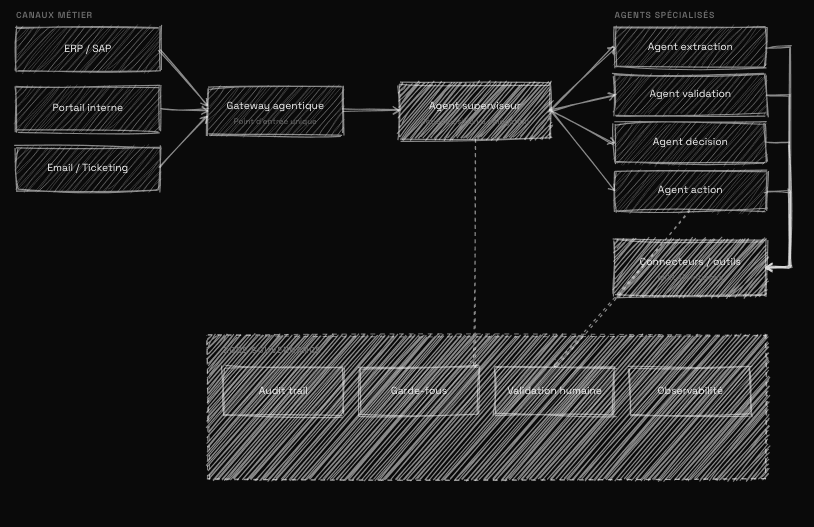
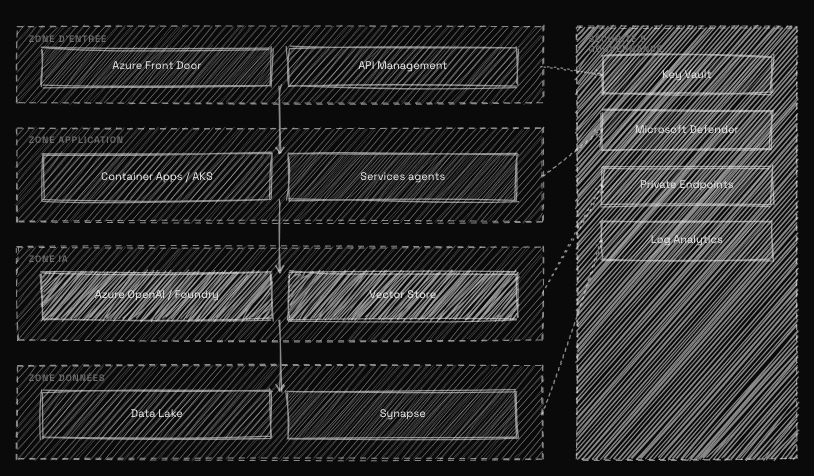
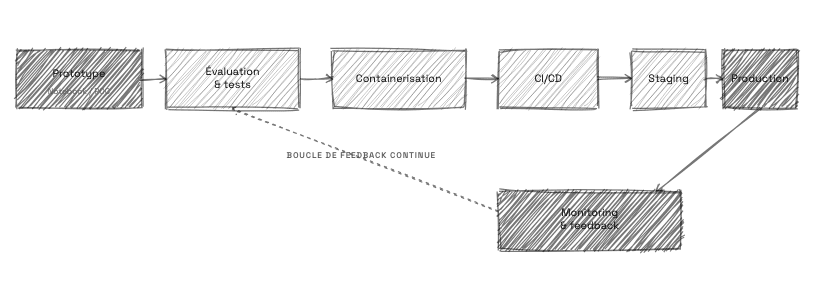
These diagrams illustrate what we actually deliver: agentic orchestration patterns, infrastructure requirements we specify to your teams or cloud partners, and industrialization pipelines. Click a diagram for the detailed view and the technical trade-offs.
Solutions
The architecture that fits your context
Sovereign self-hosted or fully managed — the same layers, four ways to deploy them with the right market tools.
Testimonials
What the teams who lived through the engagement say
client-feedback
Verified→ session #01 · CIO — Top 10 insurance group
← “Paradigm came in after eight months of our extraction-agent POC stuck in pre-production. What we lacked wasn't technical, it was architectural: how to prove to our auditors that every automated decision was traceable. They solved that in weeks, not months.”
— Agentic industrialization engagement — 7 months
Contact
Let's talk about your use case, not our methodology
Describe your context in a few steps. We'll come back with a technical read, not a sales brochure.
Let's talk about your use case
A few questions, one at a time — two minutes flat. Your answers are saved as you go on this device.
Where do we start?
Careers
Building systems that run, not slide decks
We hire people who have already carried technical responsibility for a production deployment.
Senior AI Integration Engineer
Paris · Hybrid
AgentOps Engineer
Paris · Hybrid
AI Strategy Consultant
Paris · Hybrid
AI Governance Consultant — Regulated industries
Paris / Lyon · Remote