Architecture
From POC to production: the industrialization pipeline
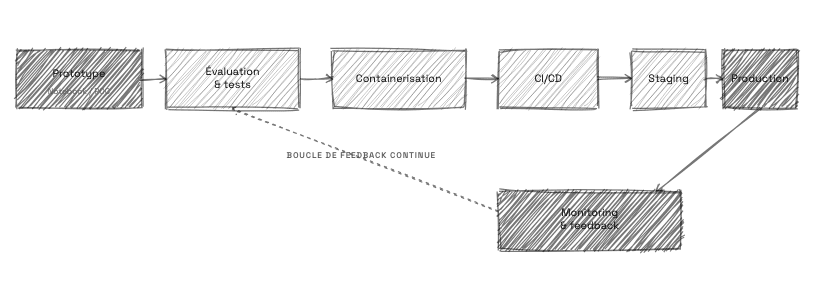
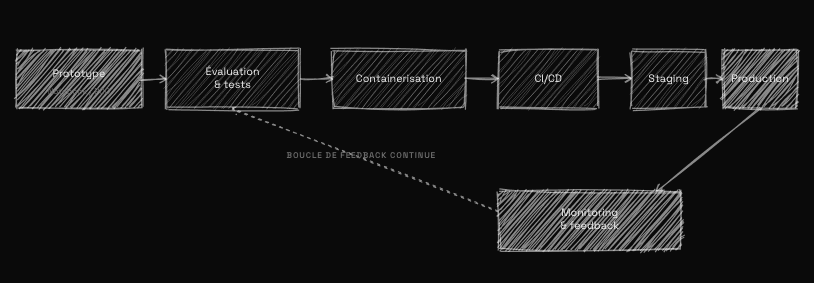
The full chain that turns a business-validated prototype into a service that's operated and continuously measured.
The pattern
This horizontal pipeline formalizes the path we systematically enforce between a business-validated prototype and a service genuinely operated in production. The prototype, usually a notebook or an isolated POC, goes through an evaluation and testing phase that measures its performance on representative datasets and its behavior on errors. Next comes containerization, which removes the dependency on the development environment, followed by a CI/CD pipeline that automates regression testing before any deployment. Deployment itself always goes through a staging environment before production. Once in production, monitoring feeds a continuous feedback loop that flows back into the evaluation phase — industrialization is never a one-way trip.
Technical choices
Systematic evaluation before containerization: an agent that performs on demo cases but not on a representative test set should never reach CI/CD
Mandatory staging, no exceptions even under deadline pressure: it's the step clients most often try to compress under go-live pressure, and the most expensive one to skip
Feedback loop that flows back to evaluation, not to the prototype: drift in a production agent is handled through continuous re-evaluation, not a return to the exploratory phase
Trade-offs we accept
Systematically going through staging adds several days to each iteration — a cost we justify to the client as early as scoping, to avoid the trade-off being relitigated mid-engagement
The continuous feedback loop requires instrumentation from the prototype phase onward, which adds weight to the initial POC but avoids a full re-instrumentation at industrialization time