Architecture
Supervised multi-agent orchestration
The default pattern for connecting heterogeneous business channels to specialized agents, under human supervision.
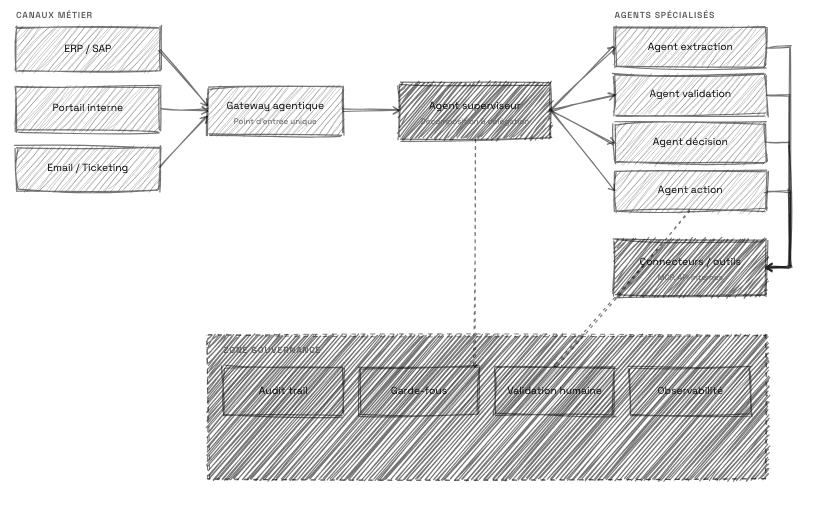
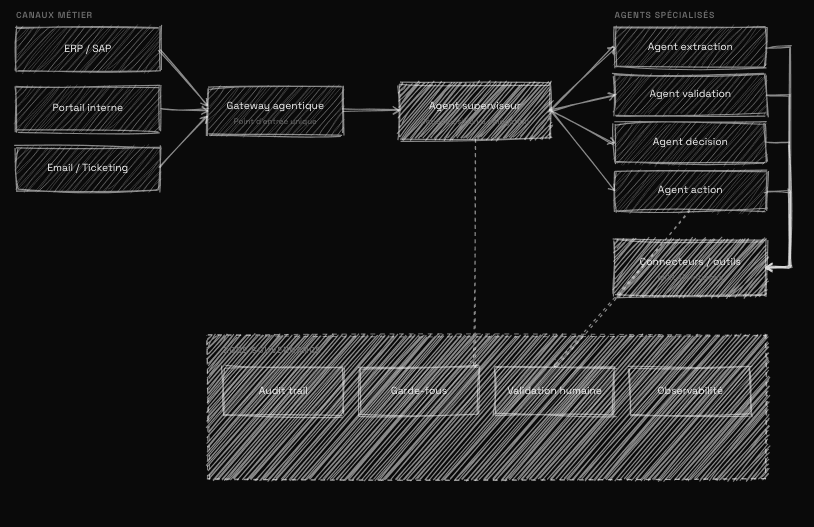
The pattern
This diagram illustrates the orchestration pattern we deploy by default when a client needs to connect several business channels (ERP/SAP, internal portal, email/ticketing) to specialized agents without sacrificing traceability. A single agentic gateway receives all incoming requests and forwards them to a supervisor agent, responsible for decomposing the task and delegating to specialized agents: extraction, validation, decision, action. Each specialized agent has its own tools and connectors (via the MCP protocol or internal APIs), but no business-critical action is executed without passing through the governance zone, which maintains the audit trail, enforces the guardrails defined with the client, and triggers human validation past a confidence or amount threshold.
Technical choices
Single agentic gateway as the entry point: simplifies observability and access control, at the cost of a centralization point that needs to be sized correctly
Explicit supervisor agent rather than event-driven choreography: simpler to audit, better suited to regulated contexts where traceability matters more than latency
MCP connectors for internal tools: interoperability between agents and existing systems without coupling the architecture to a model provider
Cross-cutting governance zone, not an optional module: audit trail, guardrails and human validation are designed as architectural constraints, not features bolted on afterward
Trade-offs we accept
The centralized supervisor introduces extra latency compared to a direct choreography architecture — acceptable for nearly all business use cases, to be ruled out for sub-second response needs
Systematic human validation past a threshold slows theoretical throughput but remains the condition for the system to be accepted by business teams and auditors in regulated industries